
9 Ocean Shipping Export Packing Standards for Knock-Down Steel Cabinet Packaging
A knock-down steel cabinet travels as flat panels, and that is exactly why its condition on arrival depends on one thing above all: the packaging. Across every ocean shipping export packing cycle — repeated lifting, stacking, vibration and sharp swings in temperature and humidity — weak packing turns into dented corners, scratched powder coating and condensation rust.
This guide breaks down the knock-down steel cabinet packaging standards applied before any container leaves the factory: the six-layer protective structure, anti-rust packaging for high-humidity and salt-spray routes, acceptance checks and loading practice — so overseas buyers can inspect export packing and stop arrival damage before it starts.
01Why Ocean Shipping Is Hard on Knock-Down Steel Cabinet Packaging
Sea freight is never a gentle ride. Knowing what happens between the factory gate and the destination port tells you exactly what knock-down steel cabinet packaging has to defend against — containers carry most of the world's ocean cargo, as the World Shipping Council documents, and every one of those boxes is lifted, stacked and shaken many times en route.
- Repeated lifting and stacking — cabinets are craned and tiered at terminals and on board, so compression and impact risks run high.
- Long-haul vibration — panels rub against each other and scratch without separation layers between them.
- Temperature and humidity swings — crossing temperate and tropical zones creates condensation inside the container, and condensation rusts steel.
- Salt spray — coastal and high-humidity routes carry salt-laden air that accelerates corrosion on any unprotected surface.
- Mixed consignments — loose panels from different kits knock against each other and get confused unless every kit is marked as a set.
02The Six-Layer Structure of Qualified Knock-Down Steel Cabinet Packaging
A qualified knock-down steel cabinet packaging set is built from the inside out, one layer solving one problem — and no layer can be skipped.
- Inner protection — every single panel is wrapped in PE film so the board face never touches anything abrasive.
- Middle dividers — hardboard or foam sheets sit between panels so surfaces never meet directly.
- Edge reinforcement — corner guards and foam strips protect the edges and corners, the most damage-prone spots of any panel.
- Outer carton — a five-ply heavy-duty corrugated carton printed with part numbers and shipping marks carries load, blocks moisture and speeds identification.
- Moisture and anti-rust packaging — desiccants inside the carton; moisture-barrier bags and stretch wrap added on humid routes.
- Kit packing — all parts of one cabinet travel as one numbered set, so nothing is mixed or missing at destination.
03Layer-by-Layer Protection at a Glance
The table below is the checklist our packing line follows for every knock-down steel cabinet packaging order — use it as a reference when you inspect cartons on arrival.
| Protection layer | Packaging material | Function |
|---|---|---|
| Inner layer | PE protective film | Shields board faces against scratches |
| Middle layer | Hardboard / foam dividers | Separates panels, prevents impact |
| Edges & corners | Corner guards / foam strips | Stops dents and deformation |
| Outer layer | Five-ply corrugated carton | Load-bearing, moisture barrier, marking |
| Moisture control | Desiccant / barrier bags / stretch wrap | Absorbs humidity, prevents rust |
| Securing | Steel or PET strapping / pallets | Fixes the load, prevents shifting |
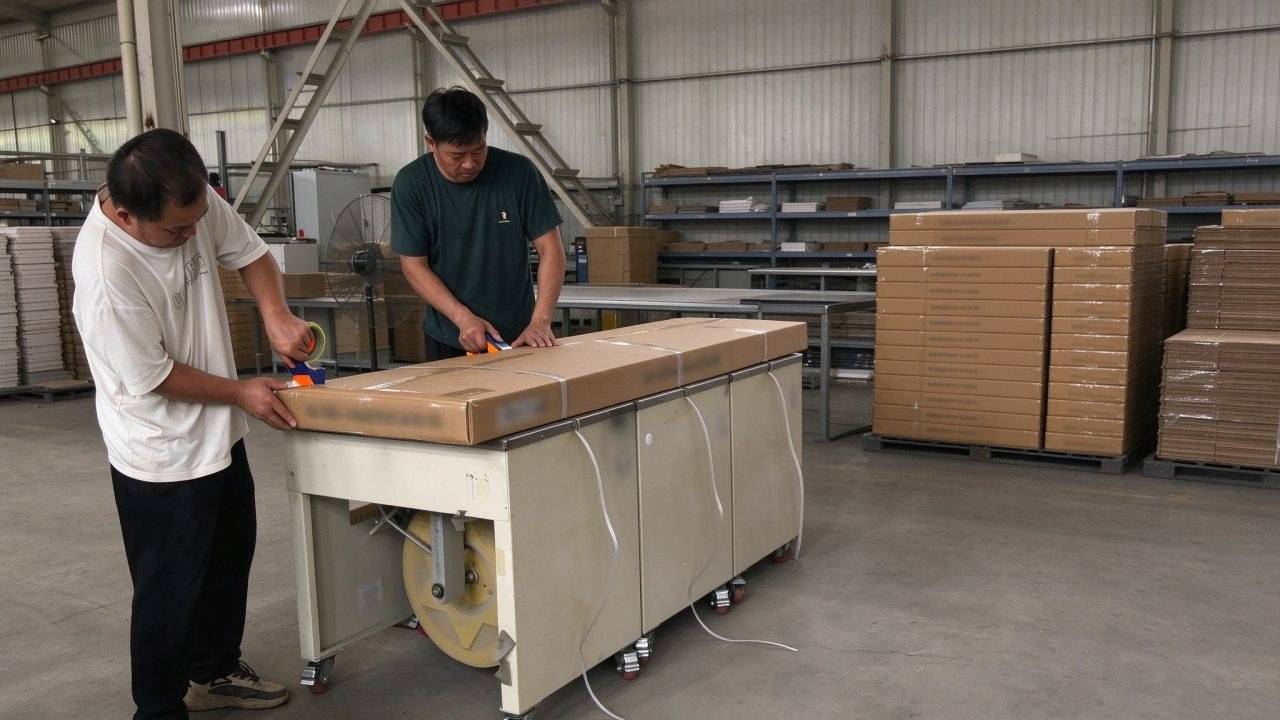
On the packing line
- Panels film-wrapped face to face
- Corner guards fitted on all edges
- Kit sealed into its export carton
- Steel strapping tensioned by machine
- Shipping marks printed on every face
04Anti-Rust Packaging for High-Humidity and Salt-Spray Routes
Steel fears two things: water and salt. That is why knock-down steel cabinet packaging is tuned to the route, not applied as one fixed recipe — a cabinet bound for a dry inland city and one crossing the equator should not travel in identical packs. Freight platforms such as SoFreight publish route and schedule data that make it easy to check what climate your cargo will actually cross.
Anti-rust packaging for tropical high-humidity routes
Desiccant dosage is increased, panels get an extra moisture-barrier film, and container desiccant bags are hung inside to fight condensation — the number one cause of arrival rust on equatorial routes.
Anti-rust packaging for salt-spray coastal routes
Hardware is upgraded to stainless steel, the phosphating and powder-coating layers are checked for full coverage, and rust-preventive oil or VCI paper is added to bare metal parts before the carton is sealed.
Condensation control and long-term storage
Packs leave ventilation gaps so condensation can escape instead of pooling, and kits held in storage are sealed in stretch wrap and inspected periodically rather than left open to humid air.
05Knock-Down Steel Cabinet Packaging Differences by Cabinet Type
Different cabinets fail in different ways, so knock-down steel cabinet packaging is adjusted cabinet by cabinet instead of using one layout for everything.
- Flat filing cabinets — many panels; film plus dividers plus cartons focus on keeping large faces flat and scratch-free.
- Drawer units — slides and front panels are vulnerable; drawers are packed separately with buffering at the runner.
- Multi-door wardrobes — big doors dent easily; door edges get reinforced corner guards as standard.
- Custom and shaped cabinets — shaped panels receive purpose-cut guards, because a generic guard never fits a special profile properly.
06Knock-Down Steel Cabinet Packaging Materials and Quality Checks
Material quality decides whether knock-down steel cabinet packaging actually works. When you audit a supplier's packing, check these details on the spot.
- Carton gram weight — five-ply board outperforms three-ply; sample the thickness and flute profile to confirm it is as specified.
- Corner guard material — paper or plastic guards and foam strips all work, as long as they hug the edge and are fixed tight.
- Desiccant type and dose — silica gel or mineral desiccant must match the carton volume and route humidity; check they are present and not saturated.
- Shipping marks — part numbers, marks, fragile and keep-dry icons printed on the outer faces speed up counting and careful handling.
- Strapping and pallets — kits strapped into units and palletized stay put; loose cartons migrate inside a moving container.
07KD vs Fully Welded: Why Flat Packs Travel Better
Put the two side by side and the reason KD cabinets suit ocean freight becomes obvious. A welded cabinet ships as a finished product with doors, frames and drawers protruding — exactly the parts that crush and deform first at sea, demanding thicker buffering and bigger cartons that waste space. A knock-down cabinet ships flat: surfaces are flat, corners are controlled, and film plus dividers plus corner guards protect it effectively in a compact carton that loads anywhere in the container. Higher loading density and more effective protection stack together — which is why KD wins on total landed cost, not just on the freight line. For a deeper comparison of the two structures, see our knock-down vs welded steel cabinet breakdown.
08Damage Responsibility and Claims: Get It in the Contract
One clause is overlooked more than any other: who pays when something arrives damaged. Whether damage after ex-works is the supplier's, or damage after arrival goes through marine insurance, changes the outcome completely. Agree in writing before ordering: the export packing standard by name, the boundary of damage-replacement liability, and the claim window and process. If a carton opens damaged at destination, photograph it immediately, cross-check against the loading record and shipping marks, and file with the supplier or insurer without delay — that is how losses stay small. Packaging is not just wrapping; it is the first line of defense for on-time overseas delivery, and it deserves the same scrutiny as cabinet quality.
09Packing Acceptance and Container Loading Checklist
Inspect knock-down steel cabinet packaging at the factory and control the loading, and you stop most risks before the container door closes.
- Acceptance — sample carton thickness, confirm film, desiccant and corner guards are all in place.
- Pre-loading check — kits complete, part numbers legible, quantities correct, so nothing turns up missing at destination.
- Stowage — heavy cartons low, light ones high, flat panels laid level with ventilation gaps, and no tower stacked so high the base cartons crush.
- Records — photo and video the packing and loading; that footage is your evidence file for any claim.
Loading practice matters as much as knock-down steel cabinet packaging itself. Keep stacking heights moderate and add pallet bases under tall columns; zone heavy and light items separately, laying door and side panels flat while small hardware and shelves box together; fill and strap so cargo cannot shift in a rolling sea; and adjust the packing grade for peak-season handling while never relaxing the acceptance standard. Combined with a qualified pack, these details are what actually push the damage rate down.
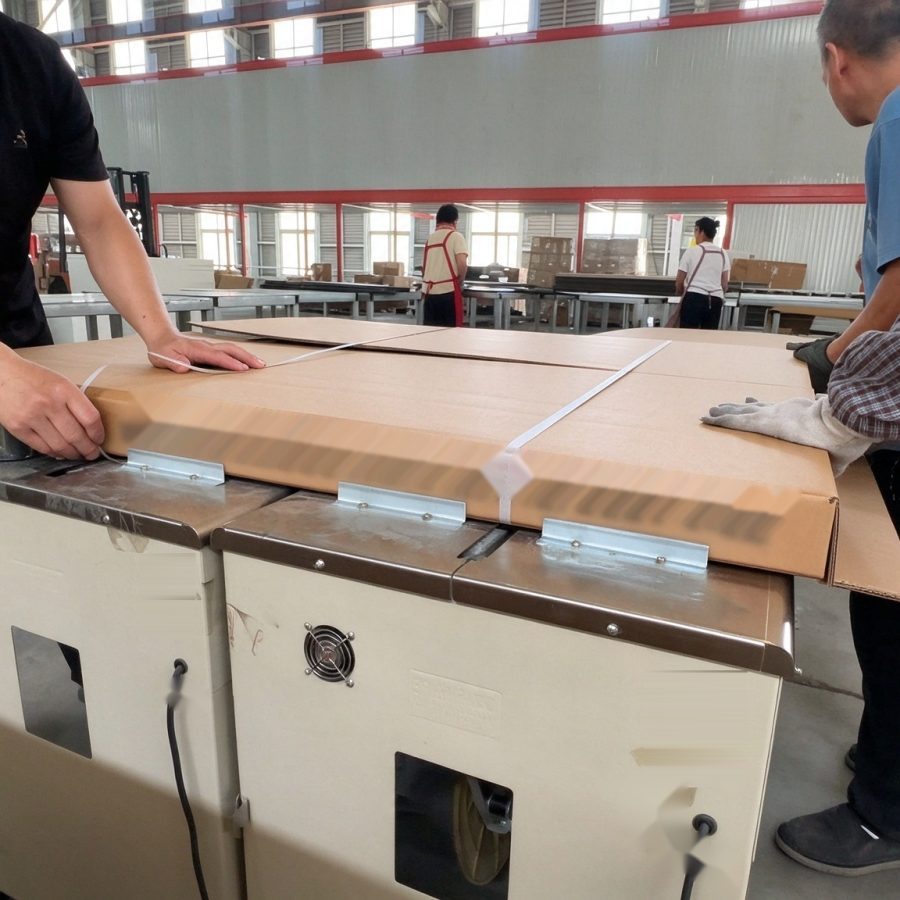
One kit, one strap, one mark
Each finished kit is compressed and strapped into a single rigid unit before it meets its carton. The strap tension is set so panels cannot micro-move in transit, yet the carton still opens cleanly at destination without tools.
Because every kit carries the same set number on each face, a mixed container can be sorted by kit in minutes — and any carton that opened en route is identified against the loading record the same day it lands.
This is also the moment the pack gets its final audit: film intact, guards seated, marks legible. A kit that fails any of the three goes back to the bench, not into the container.
10Five Export Packing Mistakes Overseas Buyers Should Avoid
Knock-down steel cabinet packaging failures rarely show up at the factory — they surface when the container is opened, when replacement and rework are already expensive. Steer clear of these five.
- Buying on unit price alone — cheap cabinets often cut packing first: thin cartons, no guards, too little desiccant. The arrival damage and replacement cost erase the discount.
- Assuming flat panels cannot break — coated thin steel still dents and scratches; every layer of the pack exists for a reason.
- Ignoring the route climate — inland short hauls can be simpler, but cross-ocean, humid and salt-spray routes demand full anti-rust packaging, or condensation rust becomes routine.
- Leaving acceptance and claims out of the contract — without written packing standards and liability terms, a damage claim becomes an argument.
- Stowing carelessly — heavy on light, stacked too high: even a perfect pack fails under bad loading.
Avoid these five, combine a standard pack with disciplined loading, and knock-down steel cabinet packaging lets cabinets arrive ready to assemble. The packing budget looks like a cost; measured against replacement, rework and after-sales, it is one of the cheapest lines in the project.
11FAQ: Export Packing Questions We Hear Most
Q1.Is desiccant really necessary for ocean-going KD cabinets?
On cross-zone and high-humidity routes, strongly recommended — anti-rust packaging without desiccant leaves condensation free to rust the panels inside a sealed carton.
Q2.Do flat panels get damaged more easily than welded cabinets?
No. Knock-down steel cabinet packaging travels with film, dividers and corner guards, so damage concentrates only at edges; welded cabinets expose whole doors and frames that crush and deform first.
Q3.Does a higher packing grade raise the quotation much?
The material cost of a qualified pack is modest, and it cuts damage-replacement costs sharply — over a full project it is the cheaper option.
Q4.What extra protection applies on salt-spray routes?
For knock-down steel cabinet packaging on salt-spray routes: stainless hardware, verified phosphating and coating coverage, rust-preventive oil or VCI paper plus desiccant, and reinforced stretch-wrap sealing where needed.
Q5.What should I do if I find damage when opening containers?
Keep the loading records and arrival photos, notify the supplier immediately, and process under the contract's damage-replacement clause — via marine insurance where applicable.
GetYour Knock-Down Steel Cabinet Packaging Plan
Shengmei Cabinet supports overseas office, school, apartment and archive projects with knock-down steel cabinet packaging plans, anti-rust packaging and container loading planning, adapted for tenders at home and abroad. Browse the full steel cabinet range at shengmeifurniture.com.