
Powder Coating Scratch Test: 7 Checks for Knock-Down Steel Wardrobe
The complete coating process chain, the ISO and ASTM test standards behind scratch resistance, and the delivery checks that keep a knock-down steel wardrobe finish intact for years.
A knock-down steel wardrobe is only as good as its finish. The powder coating scratch test grade, not the colour, decides whether the surface resists rust, wear and scratches for years. Two wardrobes pressed from the same steel coil can differ by several years of service life purely because of their coating process.
In overseas school dormitories, apartments and staff changing rooms, wardrobes are opened, bumped and wiped down every day, so whether the surface passes a proper powder coating scratch test often decides the real cost of ownership. This guide breaks the subject into seven checks — process chain, coating method, quality indicators, test standards, scenario grades, acceptance and FAQ — so overseas buyers can read and verify coating quality before signing the order.
01The Complete Powder Coating Process Chain
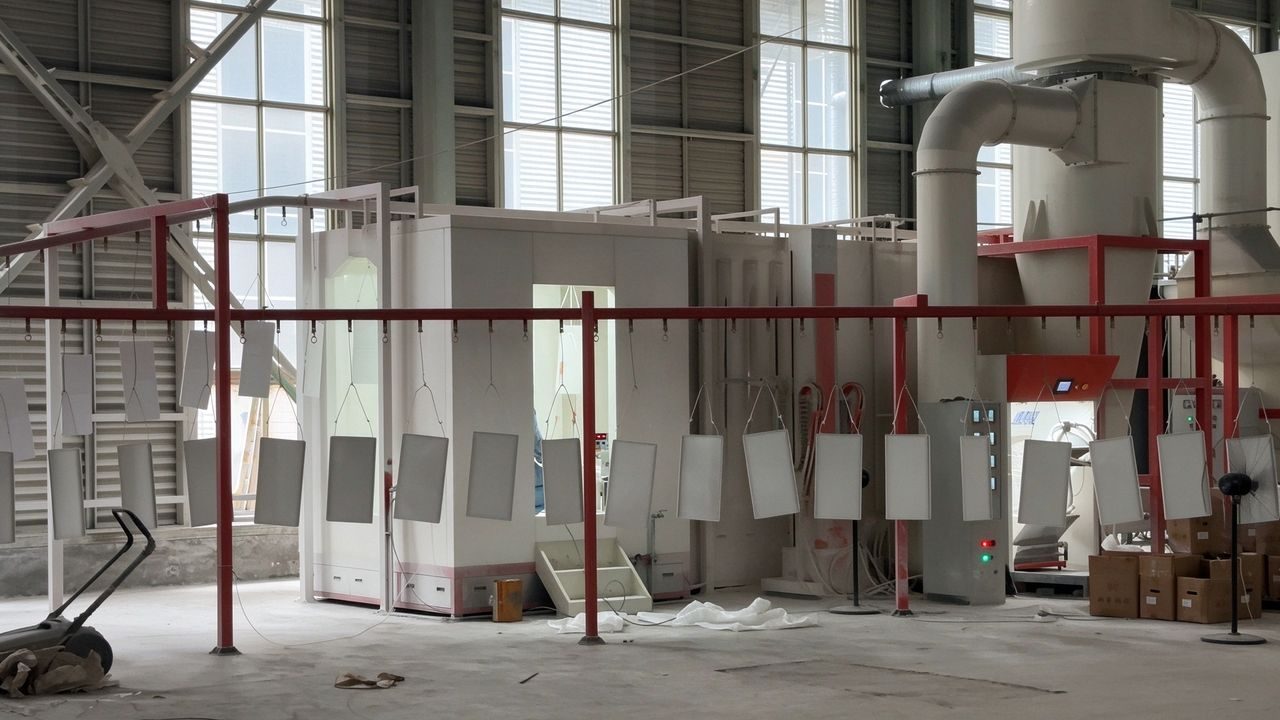
Surface treatment on steel wardrobes is never just “a coat of paint”. It is a chain of interlocked processes, and any weak link shows up two or three years later as rust or peeling. A complete powder coating line normally runs the following five steps.
- 1Surface degreasingDegreasing agents remove oil, dust and impurities from the steel sheet. If the surface is not clean, the coating cannot grip it.
- 2Acid picklingPickling solution strips mill scale and rust, exposing clean base metal. This step decides how firmly the coating can adhere.
- 3Phosphating and passivationA phosphate conversion film forms on the steel, boosting adhesion and rust resistance. This is the key anti-corrosion step that low-cost cabinets most often skip.
- 4Electrostatic powder sprayingCharged powder is attracted evenly onto the steel surface, edges and bend zones included, under high voltage.
- 5High-temperature curingPanels pass through a curing oven at roughly 180–200°C, where the powder melts, levels and hardens into a dense, wear-resistant film.
Every step matters. Pickling and phosphating decide anti-rust performance and adhesion; spraying and curing decide surface hardness and wear resistance. Buyers who compare only colours while ignoring pre-treatment are the ones who end up with cabinets that look fine on delivery and rust within two years.
02Why Electrostatic Powder Coating Wins
Electrostatic powder coating is the mainstream finish for steel furniture today, and it has replaced liquid paint across the knock-down steel wardrobe industry. Four technical advantages explain why.
- Even coverage by electrostatic attraction. Powder particles carry a charge under tens of kilovolts and wrap onto the steel, including edges and bends that liquid paint struggles to reach.
- Solvent-free and low-VOC. Powder contains no volatile organic solvents, so production is cleaner and the finish meets the environmental rules of overseas markets — a trend tracked across the China coatings industry.
- Thick film in one pass. A single spraying pass builds a thicker, more uniform film that hides small defects in the steel substrate.
- Hard, dense, scratch-resistant surface. After curing, the film is hard and tight — exactly what high-frequency use in schools, dormitories and changing rooms demands.
Compared with liquid paint, powder coating clearly wins on environmental profile, coverage evenness, hardness and wear resistance — which is why overseas office, education and apartment projects specify it. When in doubt, ask the supplier whether the product is powder coated or liquid painted; powder coating is normally the more durable choice.
03Powder Coating Quality: Adhesion, Leveling and Film Thickness
Coating quality is not judged by gloss alone. Four hard indicators decide how the finish performs over years of service.
- Adhesion — how firmly the coating bonds to the steel. Weak adhesion means the film peels first at bends and impact points.
- Leveling — whether the surface is smooth and flat, free of runs, pinholes and orange peel. Poor leveling also traps dirt.
- Film thickness — too thin gives weak rust and wear protection; too thick turns brittle. Powder coating on steel furniture typically measures around 60–80 μm, subject to the product standard.
- Colour consistency — cabinets in one batch must match. Spot-check bulk orders to avoid mixed shades across batches and components.
Of the four, adhesion is the core indicator that decides the life of the whole coating system. A simple cross-cut and tape test gives a first judgement — the standards behind it are covered next.
04Scratch Test Standards for Powder Coating: ISO & ASTM
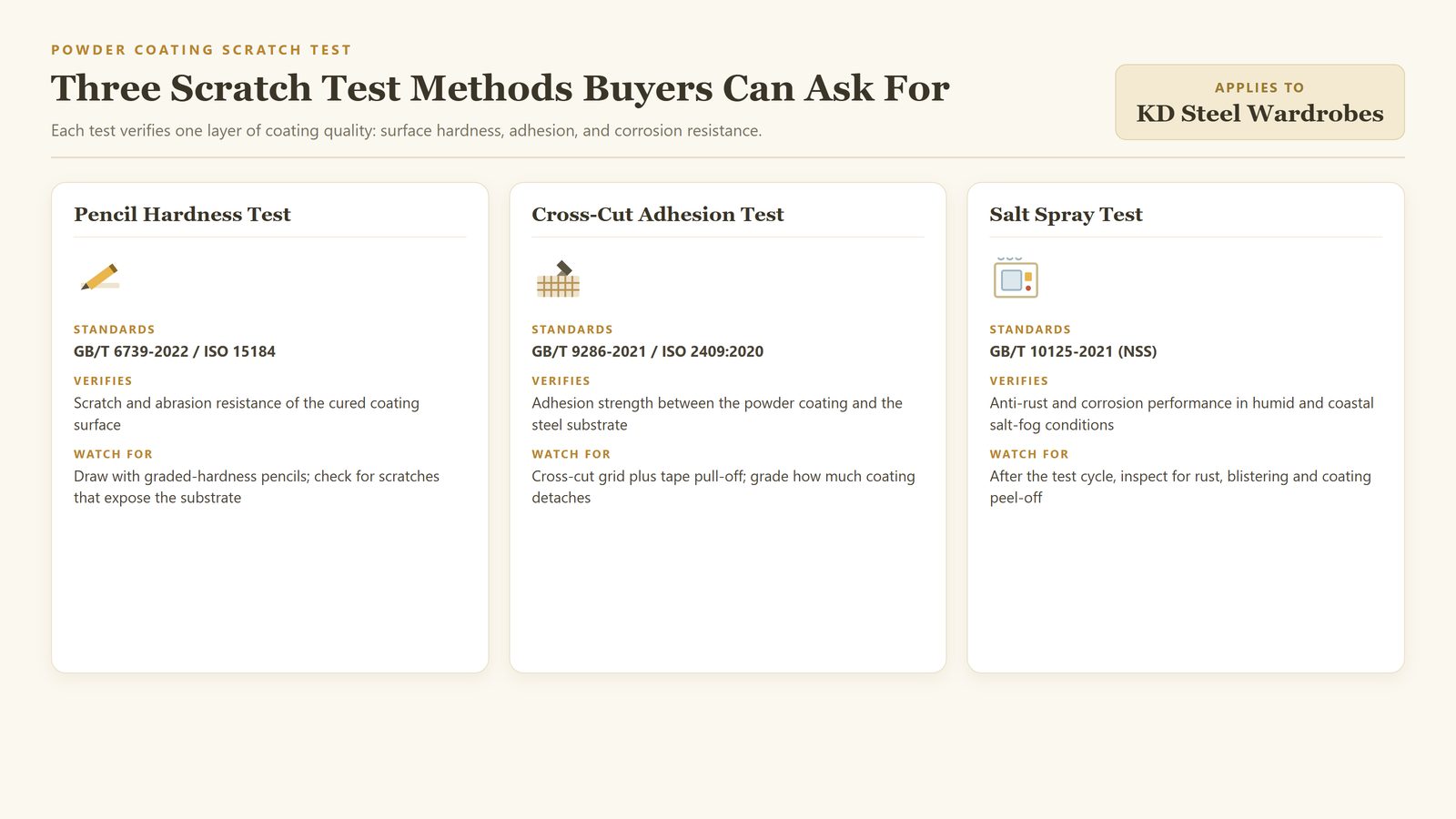
Scratch resistance is a specified, testable property, not a sales adjective. The methods below are international standards used across the metal coating industry, and overseas buyers can and should ask suppliers for reports issued against them.
- APencil hardness test — ISO 15184 / ASTM D3363Pencils of graded hardness are drawn across the film under fixed pressure; the result is the hardest pencil that does not scratch through.
- BCross-cut adhesion test — ISO 2409 / ASTM D3359A grid is cut into the film, tape is pressed on and pulled off, and the share of detached squares grades the adhesion.
- CSalt spray test — ISO 9227 (NSS)Panels sit in a salt-fog chamber for a set number of hours; inspectors then check for rust, blistering and peeling to assess corrosion resistance.
- DImpact resistance testA weighted punch strikes the coated panel from a fixed height, simulating knocks during transport and daily use.
These are real, verifiable test methods, not marketing claims. Ask for the corresponding reports before contract signing, and write the acceptance grades into the contract itself.
05Powder Coating Scratch Grades by Use Scenario
Different scenes abuse wardrobe finishes differently, so the required scratch-resistance grade differs too. Match the grade to real usage intensity instead of paying for the top grade everywhere.
| Scenario | Usage pattern | Recommended grade |
|---|---|---|
| School dormitory wardrobes | Heavy daily use, frequent moves, student knocks | High scratch & wear resistance |
| Staff changing-room lockers | Daily opening, frequent knocks | Medium-high grade |
| Apartment wardrobes | Normal household use | Medium grade, appearance matters |
| Archive and filing rooms | Load-bearing, little contact | Moderate scratch grade, high anti-rust |
| Hotel guest-room wardrobes | High guest turnover, appearance-led | High grade + premium finish |
In short, the rougher the usage, the higher the required grade. Define where the cabinets will actually go, then choose the grade — durable enough for the scene, without overpaying for protection it will never need. For layout inspiration, see how knock-down steel wardrobes are arranged in 5 school dormitory storage setups.
06How to Acceptance-Check Powder Coating on Delivery
Coating and scratch quality can be verified on arrival — you do not have to take the supplier’s word for it. Four hands-on checks cover the essentials.
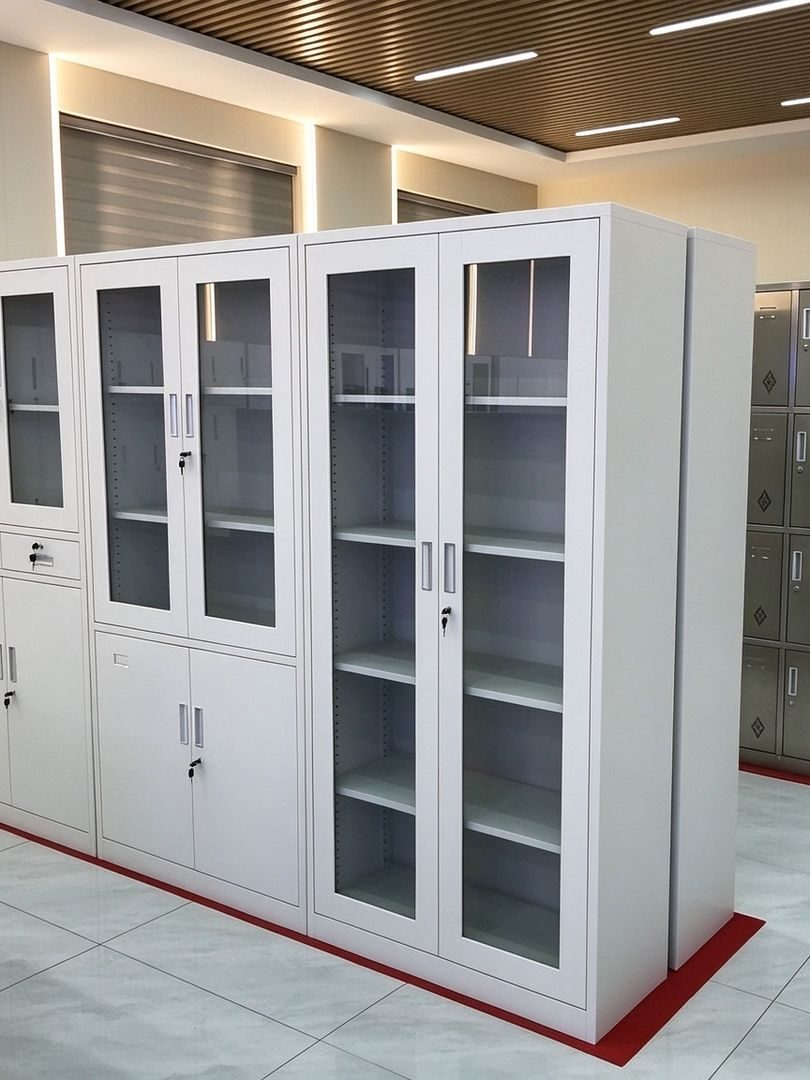
- Inspect the finish. Look for a fine, even surface without runs, pinholes, orange peel or colour shift; a good film is smooth and fully covers edges.
- Run a simple tape test. Press adhesive tape firmly on the surface and pull it off quickly; heavy powder loss signals weak adhesion, and a fingernail along a bend should not lift the film.
- Collect the reports. Ask for cross-cut (ISO 2409), salt spray (ISO 9227) and pencil hardness (ISO 15184) reports, and match the grades against your contract.
- Confirm pre-treatment. Check that pickling and phosphating were actually performed — the step low-cost cabinets most often skip, and the one that decides anti-rust life.
Finish capacity matters for bulk programmes as much as test reports — our 4K colour-printing line doubled our wardrobe finish capacity to keep large orders on schedule.
07Powder Coating Scratch Test FAQ
Not when the cabinet is powder coated after full pickling and phosphating — adhesion is strong and normal use will not lift the film. Cheap cabinets that skip pre-treatment are the ones that peel.
Both. Pencil hardness (ISO 15184) measures scratch and wear resistance; the cross-cut test (ISO 2409) measures whether the film detaches. Together they decide the life of the coating.
Confirm complete phosphating plus powder coating and conforming film thickness, and always request a salt spray report to ISO 9227 for coastal projects.
Around 60–80 μm is common on steel furniture, subject to the product standard. Too thin protects poorly against rust; too thick turns brittle.
Panels are coated flat and assembled afterwards, so normal handling and assembly will not scratch the finish; keep protective interlayers between loose panels during transport.
Project Consultation for Overseas Buyers
Shengmei Cabinet supports overseas office, school, apartment and archive projects with knock-down steel wardrobes, custom powder coating finishes, and verified scratch and anti-rust standards — suitable for global tenders.